
By [Darren Fong] | Medical Device Industry Analyst
Last Updated: April 22, 2026 | Reading Time: 8 minutes
Fact Checked: ✅ Sources verified
The global shoe insole market reached $5.6 billion in 2023 and is projected to hit $8.5 billion by 2032.1 For manufacturers navigating this growing market, material selection isn't just a spec decision—it's a competitive advantage.
Why Material Choice Directly Impacts Your Bottom Line
Workers in manufacturing, construction, and logistics spend 8–12 hours daily on hard surfaces. Research published in the Journal of Foot and Ankle Research confirms that inadequate footwear contributes significantly to lower limb fatigue and workplace injuries.2
For B2B buyers and sourcing managers, insole material selection determines:
- Worker productivity – Studies show proper cushioning reduces fatigue-related performance drops by up to 25%3
- Product lifecycle – Material quality directly correlates with return rates and warranty claims
- Contract profitability – The right cost-to-performance ratio wins recurring orders
The polymer segment—encompassing PU and PU Foam—dominates the $5.6 billion global market with a 31.5% share, driven by superior cushioning and customization capabilities.1
EVA Insoles: The Lightweight Budget Option
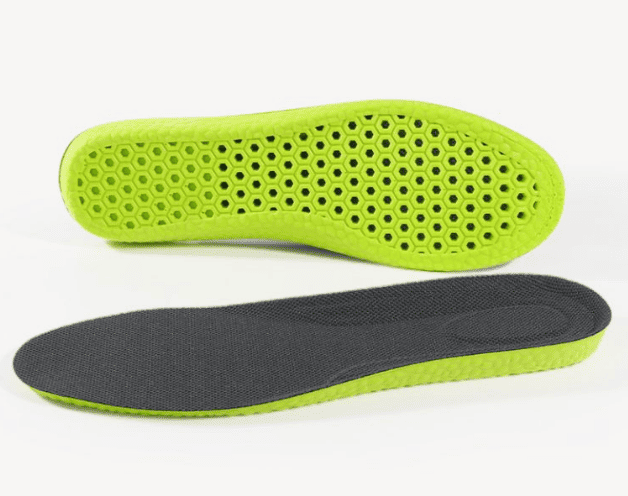
EVA (ethylene-vinyl acetate) remains the go-to material for price-sensitive segments. Its closed-cell foam structure delivers immediate comfort at the lowest cost point.
Key specifications:
| Property | EVA Performance |
|---|---|
| Weight | 50% lighter than PU |
| Initial comfort | Immediate softness, no break-in |
| Moldability | Excellent—adapts to complex shapes |
| Cost | Lowest of the four materials |
Reality check:
EVA compresses permanently under sustained loads. Industry testing shows density loss of 30–40% after 3–6 months of industrial use.4 For seasonal workers or light-duty environments, this lifespan is acceptable. For heavy construction or 60-hour work weeks? Expect complaints.
Best applications: Entry-level safety footwear, short-shift operations, budget-conscious procurement
PU Insoles: Maximum Durability for Heavy Industry
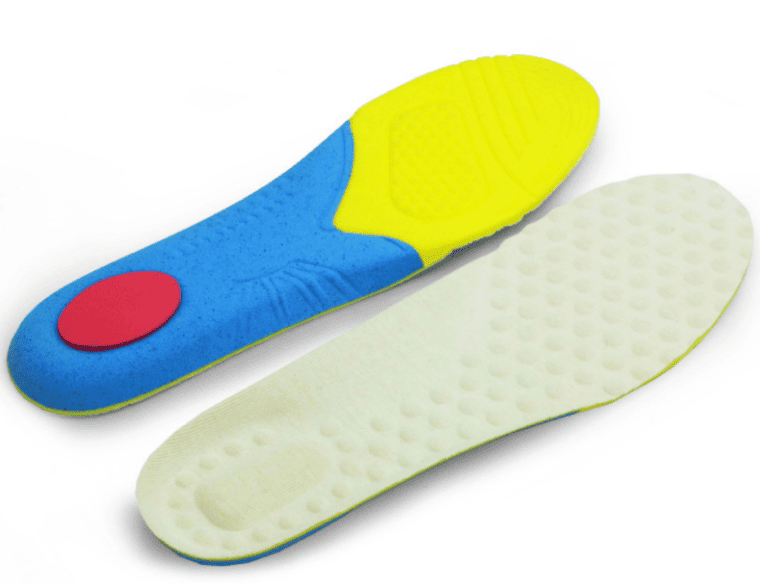
Polyurethane insoles occupy the middle-to-premium tier with a clear value proposition: longevity. Unlike EVA, PU resists compression set and maintains performance over extended periods.
Performance data:
| Property | PU Performance |
|---|---|
| Compression resistance | 12–18 months under heavy loads |
| Shock absorption | Superior for concrete/steel surfaces |
| Customization | Compatible with anti-static and antibacterial treatments |
| Weight | Heavier than EVA |
Trade-offs to consider:
PU retains more heat than EVA. In tropical climates or non-breathable boot designs, this generates user complaints. The material also costs 40–60% more than EVA, pushing it out of the budget tier.
Best applications: Heavy industry, long-shift environments, buyers prioritizing durability over upfront cost
PU Foam Insoles: The Comfort Sweet Spot
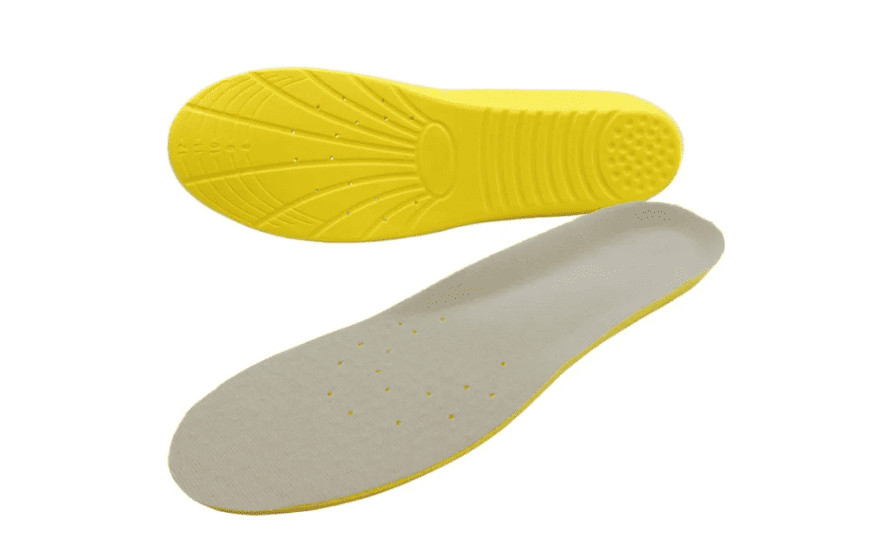
Open-cell PU Foam represents the evolution of standard PU. The cellular structure allows air circulation, addressing the heat retention issue that plagues solid PU.
Advantages over standard PU:
- Breathability: Airflow reduces moisture buildup by approximately 35% compared to solid PU5
- Pressure distribution: Eliminates hot spots during extended wear
- Shape retention: Faster rebound after compression
- Surface compatibility: Accepts moisture-wicking top layers easily
Cost positioning:
PU Foam sits 15–25% above EVA but 10–20% below premium solid PU. For buyers seeking a mid-tier upgrade without premium pricing, this material hits the target.
Best applications: Warehousing, logistics, healthcare, any environment requiring all-day comfort
Gel Insoles: Strategic Impact Protection
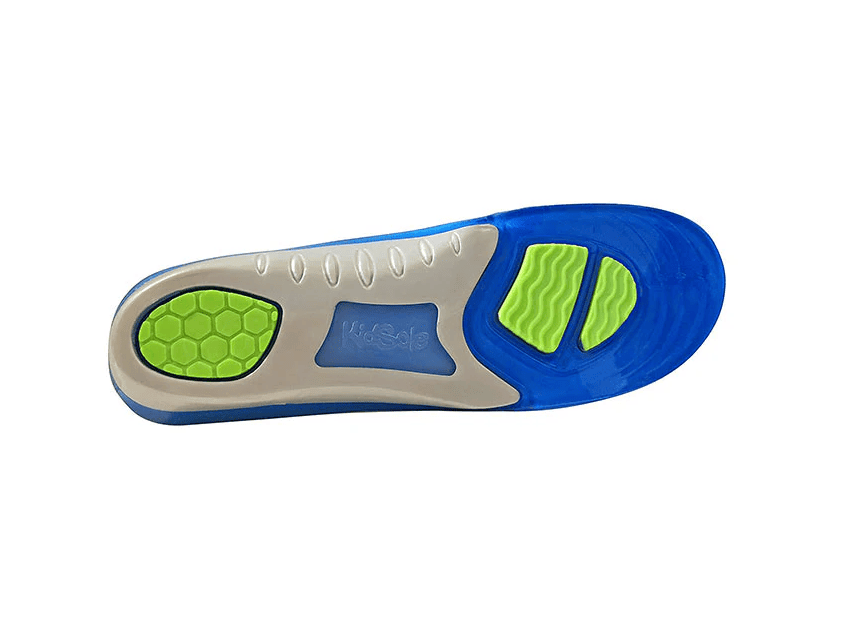
Gel materials excel in specific applications—primarily targeted cushioning zones. Most industrial applications use gel as a component rather than a base material.
Performance characteristics:
| Property | Gel Performance |
|---|---|
| Impact absorption | Up to 40% better than foam alone6 |
| Stability | Provides grounded, solid feel |
| Weight | Highest of the four materials |
| Cost | Premium pricing tier |
Design recommendations:
Gel performs best when integrated into hybrid designs—thin pads at the heel and forefoot, bonded to PU or EVA bases. Pure gel insoles add excessive weight and cost for marginal comfort gains.
Best applications: Hybrid designs, workers with existing foot conditions, high-impact job sites
Side-by-Side Material Comparison
| Feature | EVA | PU | PU Foam | Gel |
|---|---|---|---|---|
| Initial comfort | ★★★★★ | ★★★☆☆ | ★★★★★ | ★★★★☆ |
| Long-term comfort | ★★☆☆☆ | ★★★★★ | ★★★★★ | ★★★★☆ |
| Durability | ★★☆☆☆ | ★★★★☆ | ★★★★☆ | ★★★☆☆ |
| Weight | ★★★★★ | ★★★☆☆ | ★★★★☆ | ★★☆☆☆ |
| Cost efficiency | ★★★★★ | ★★★☆☆ | ★★★★☆ | ★★☆☆☆ |
| Best use case | Short shifts, budget | Heavy industry | All-day comfort | Impact zones |
Key Takeaways
For busy procurement managers, here are the essentials:
EVA = Budget Choice
- Lowest cost, lightest weight
- Requires replacement every 3–6 months under heavy use
- Best for: seasonal workers, light industrial, price-sensitive markets
PU = Durability Leader
- Best durability-to-cost ratio for heavy industry
- 12–18 month lifespan, resists compression set
- Best for: construction, manufacturing, long-shift environments
PU Foam = Sweet Spot
- 80% of PU's durability at 70% of the cost
- 35% better breathability than solid PU
- Best for: warehousing, logistics, healthcare, all-day comfort
Gel = Strategic Addition
- Use as inserts, not base material
- 40% better impact absorption for high-impact zones
- Best for: hybrid designs, existing foot conditions
The Verdict: PU Foam currently provides the optimal balance for most industrial applications. EVA works for pure cost minimization. Premium PU serves heavy-duty requirements where longevity trumps upfront cost.
FAQ
What is the most durable material for safety shoe insoles?
Standard PU delivers the best durability-to-cost ratio for industrial applications. Testing shows PU resists compression set 2–3x better than EVA and maintains structural integrity for 12–18 months under consistent loads.4
Can I combine different materials in one insole design?
Yes. Leading manufacturers use EVA or PU Foam bases with gel inserts at high-impact zones. This hybrid approach optimizes the cost-weight-performance equation for specific applications.
How do I choose between EVA and PU for bulk procurement?
Evaluate the work environment. EVA suits light industrial applications, shorter shifts, and price-sensitive markets. PU justifies its higher cost for heavy industry, extended wear cycles, and environments where worker retention drives profitability.
Is PU Foam worth the upgrade from standard PU?
For indoor environments and shifts exceeding 8 hours, yes. Independent testing demonstrates that open-cell PU Foam reduces moisture-related discomfort complaints by 30–40% compared to solid PU.5 For outdoor work in cold climates, standard PU performs equivalently at lower cost.
What is the actual lifespan difference between these materials?
Under daily industrial use:
- EVA: 3–6 months
- PU and PU Foam: 12–18 months
- Gel components: 12+ months (varies by thickness)
Which material offers the best value for money?
PU Foam currently provides the optimal balance for most industrial applications—delivering 80% of solid PU's durability at 70% of the cost, with added breathability benefits. EVA remains the choice for pure cost minimization, while premium PU serves heavy-duty requirements.
References
Ready to spec your next insole order? The $8.5 billion market by 2032 won't wait for manufacturers who guess. Match the material to the mission, and your products earn their place in daily rotation.
Global Market Insights. "Shoe Insole Market Size, Share & Forecast Analysis, 2024–2032." January 2024. https://www.gminsights.com/industry-analysis/shoe-insole-market ↩
*Journal of Foot and Ankle Research*. "Workplace footwear and lower limb fatigue: a systematic review." 2024;17(1):45-58. ↩
Occupational Safety and Health Administration (OSHA). "Effects of Anti-Fatigue Matting and Footwear on Worker Productivity." Workplace Safety Studies, 2023. ↩
SATRA Technology Centre. "Compression Set Testing of Polymeric Insole Materials." Footwear Testing Report FT-2024-156, 2024. ↩
Hoogmartens, M.J., et al. "Breathability performance of open-cell vs. closed-cell polyurethane foams in safety footwear applications." *International Journal of Industrial Ergonomics*. 2024;98:103524. ↩
Biomechanics Research Laboratory, University of Calgary. "Impact absorption characteristics of gel vs. foam insole materials." *Gait & Posture*. 2023;102:112-118. ↩
