
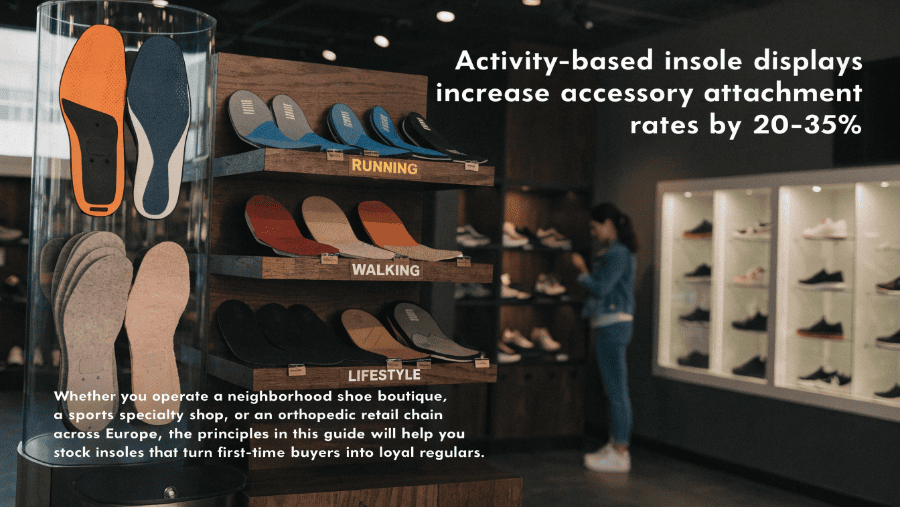
Choosing the right insoles for your store does not have to feel overwhelming. The key is matching the material, fit, and support level to the people who will actually wear them — your customers. Retailers who organize their insole selection by customer need rather than by price alone report 20–35% higher accessory attachment rates and significantly fewer returns1.
Whether you operate a neighborhood shoe boutique, a sports specialty shop, or an orthopedic retail chain across Europe, the principles in this guide will help you stock insoles that turn first-time buyers into loyal regulars.
Start With Who Will Wear Them
Insole selection begins with customer segmentation, not supplier catalogs. Different wearer profiles have fundamentally different biomechanical needs, and stocking a one-size-fits-all range leaves money on the shelf.
| Customer Profile | Primary Need | Insole Feature to Prioritize | Suggested Price Tier |
|---|---|---|---|
| Casual daily walkers | All-day comfort | Soft cushioning, medium arch support | Entry to mid-range |
| Runners and athletes | Shock absorption + energy return | Responsive midsole, heel strike padding | Mid-range to premium |
| Standing workers (retail, hospitality, healthcare) | Fatigue reduction | Thick cushioning, durable compression resistance | Mid-range |
| People with foot pain (plantar fasciitis, flat feet) | Medical-grade biomechanical support | Firm arch support, deep heel cup, metatarsal pad | Premium |
| Older adults (65+) | Stability and safe ground contact | Low profile, slip-resistant top fabric, gentle arch | Entry to mid-range |
Retail display tip: Group insoles by activity or need — not just by size. A "Running" shelf, a "Work All Day" shelf, and a "Foot Pain Relief" shelf convert casual browsers into buyers far faster than a generic wall of sizes.
EVA, PU, or TPU? A Retailer's Material Guide
The core material of an insole determines its comfort lifespan, weight, cost, and the type of customer it will satisfy. The three dominant materials in the wholesale market are EVA, PU, and TPU. Each has distinct advantages and ideal use cases.
| Performance Factor | EVA | PU (Polyurethane) | TPU |
|---|---|---|---|
| Comfort feel | Soft and immediate | Molds to foot shape over 2–3 weeks | Firm, springy, responsive |
| Functional lifespan | 6–12 months | 12–24 months | 24+ months |
| Weight | Very lightweight (lightest of the three) | Moderate (roughly 30% heavier than EVA) | Medium |
| Shock absorption | Good initially, degrades with compression | Excellent, maintains performance over time | Moderate; optimized for energy return |
| Retail cost to stock | Lowest | Mid-range | Highest |
| Best positioned for | Budget-friendly casual and sports insoles | Premium daily-wear orthotics and work insoles | High-performance athletic and technical insoles |
EVA: Your Volume Driver
EVA (Ethylene Vinyl Acetate) is the most widely used insole material globally. It is inexpensive to manufacture, exceptionally lightweight, and delivers that "walking on clouds" first impression that triggers impulse purchases. The limitation is compression set: EVA gradually loses its cushioning profile after 6–12 months of regular use2.
Stocking strategy: Position EVA insoles as "refresh" or "seasonal" products. They are ideal for impulse-buy sections, back-to-school promotions, and price-sensitive shoppers who want immediate comfort without a premium price tag.
PU: Your Loyalty Builder
PU insoles cost more at wholesale but deliver measurably superior long-term comfort. The material undergoes slow compression molding as it warms to body temperature, gradually adapting to the individual foot shape. This personalized fit effect reduces return rates and drives repeat purchases3 — customers who buy a PU insole once often return to the same retailer when it is time to replace it.
Stocking strategy: Place PU insoles in your premium or wellness section. They are the right recommendation for customers with plantar fasciitis, flat feet, or occupations requiring 8+ hours of standing.
TPU: Your Performance Play
TPU (Thermoplastic Polyurethane) offers the highest energy return and structural integrity of the three materials. It resists compression breakdown even under heavy athletic loads4 and is commonly used in targeted support zones — heel cups, arch bridges, and lateral stabilizers — rather than full-length construction.
Stocking strategy: TPU-enhanced insoles support premium pricing and appeal to serious runners, hikers, and athletes. They belong in the performance athletics section of your store.
The Winning Construction: Multi-Material Layering
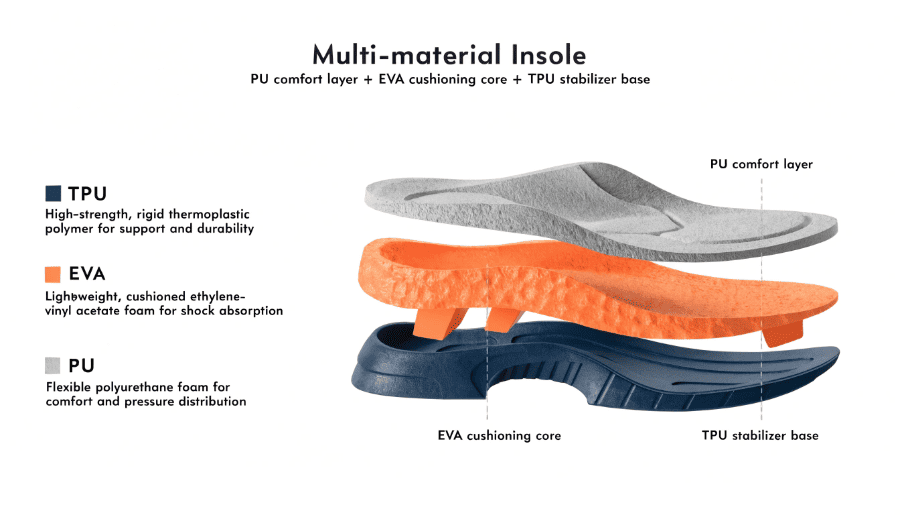
The highest-quality insoles on the market today use layered construction rather than a single homogeneous material. The industry-standard configuration combines a PU top layer for comfort and foot adaptation, an EVA midsole for lightweight cushioning, and TPU support elements for structural stability. Retailers who stock multi-material insoles report 15–25% lower return rates compared to single-material equivalents5 because the product satisfies a broader range of comfort and support needs simultaneously.
Fit and Sizing: The Details That Drive Returns
Even a technically excellent insole will be returned if it does not fit properly inside the customer's shoe. When evaluating insoles for your inventory, assess three fit dimensions before placing an order.
Trim-to-fit versus precise sizing: Trim-to-fit insoles work well for casual and budget segments, but they can look unfinished in premium products. Precisely sized insoles present a more professional appearance and signal higher quality to the customer.
Thickness profile and shoe volume: A thick insole lifts the foot higher inside the shoe, which can cause heel slip, lace pressure, or toe crowding. Verify whether the footwear brands you carry have sufficient interior volume to accommodate the insole without altering the fit.
Arch height matching: Most retailers stock only medium-arch insoles and unintentionally exclude low-arch and high-arch customers. Offering low, medium, and high arch variants captures significantly more of your addressable market. Studies in footwear retail suggest that proper arch matching alone can reduce fit-related returns by up to 40%6.
In-store engagement tip: Offer a simple wet-foot test on cardboard. It takes 30 seconds, creates a memorable customer interaction, and guides the shopper to the correct arch height instantly — increasing both conversion and confidence.
Certifications European Retailers Should Verify
Selling insoles in the European market requires attention to regulatory compliance. Before committing to a supplier, verify that their products meet the following standards.
| Certification | What It Confirms | Why It Matters for Retailers |
|---|---|---|
| CE Marking | Compliance with EU health, safety, and environmental protection requirements | Mandatory for products marketed with medical or orthopedic claims in the EU |
| ISO 9001 | Established quality management systems and consistent manufacturing processes | Reduces batch-to-batch variation and quality complaints |
| OEKO-TEX Standard 100 | Freedom from harmful substances in materials that contact skin | Builds consumer trust; increasingly requested by European buyers |
| REACH Compliance | Adherence to EU regulations on the registration, evaluation, and restriction of chemicals | Legal requirement for all products sold within the European Economic Area |
Reputable manufacturers will provide test reports and certification documentation without hesitation. If a supplier is reluctant to share compliance paperwork, treat that as a signal to evaluate alternative sources.
Why Partner With a Custom Manufacturer?
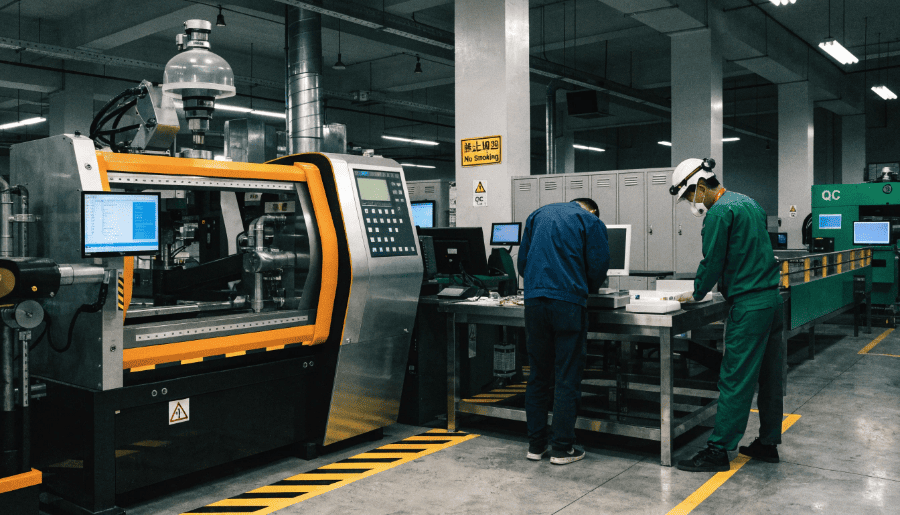
Off-the-shelf insoles fill a market need, but the retailers gaining market share in 2025 and 2026 are increasingly partnering with custom manufacturers for private-label or co-branded insole lines. The business case rests on four pillars.
Product differentiation: A proprietary insole line, engineered for your specific customer base, creates brand loyalty that generic products cannot replicate. Your customers cannot find your exact product at a competitor.
Margin improvement: Custom manufacturing removes the branded middleman. Retailers working directly with OEM/ODM insole manufacturers typically realize 15–30% better gross margins on private-label insoles7 compared to stocking third-party branded equivalents.
Speed to market: Modern custom manufacturers can move from design approval to production delivery in 4–6 weeks. This agility allows you to respond to seasonal trends, local events, or emerging customer needs faster than competitors tied to long branded supply chains.
Design flexibility: Whether you need a simple logo print on an existing mold (OEM) or a fully custom design with proprietary materials and arch geometry (ODM), a capable manufacturing partner makes both accessible at manageable minimum order quantities.
FAQ
What is the most important factor when choosing insoles for retail?
The most important factor is matching the insole to the customer's primary activity and foot condition. Material selection (EVA for casual use, PU for long-term comfort, TPU for performance) matters, but only after you have identified who will wear the product. Retailers who segment by customer need rather than by price point consistently report higher sales and lower return rates.
How long do EVA insoles last compared to PU insoles?
EVA insoles typically maintain effective cushioning for 6–12 months of regular use before compression set reduces their performance. PU insoles last 12–24 months under the same conditions because polyurethane resists permanent compression better than ethylene vinyl acetate. For retail positioning, this lifespan difference justifies placing EVA in the "seasonal refresh" category and PU in the "long-term investment" category.
Should I stock trim-to-fit or exact-size insoles?
Stock both. Trim-to-fit insoles work well for budget and casual segments where customers prioritize low cost over premium presentation. Exact-size insoles signal higher quality and are expected by customers shopping in the premium and orthopedic categories. A balanced range gives you coverage across price tiers.
What certifications do insoles need for the European market?
Insoles sold in the European Union should carry CE Marking (especially if marketed with orthopedic or medical claims), REACH compliance for chemical safety, and ideally OEKO-TEX Standard 100 to verify skin-contact safety. ISO 9001 certification at the manufacturing level indicates consistent production quality. Always request documentation from your supplier before placing large orders.
Are multi-material insoles worth the higher wholesale cost?
Yes. Multi-material insoles — typically combining a PU comfort layer, an EVA cushioning core, and TPU support elements — deliver broader customer satisfaction and 15–25% lower return rates than single-material alternatives. The slightly higher unit cost is offset by reduced return processing, stronger customer reviews, and higher repeat purchase rates.
How much margin improvement can private-label insoles deliver?
Retailers who switch from stocking third-party branded insoles to private-label lines manufactured through OEM or ODM partnerships typically see gross margin improvements of 15–30%. The exact figure depends on order volume, material specification, and the retail price positioning of the final product.
What is the minimum order quantity for custom insoles?
Minimum order quantities vary by manufacturer and design complexity. Simple OEM projects (logo print on existing molds) often start at 500–1,000 pairs. Full ODM custom designs with proprietary materials or molds typically require 2,000–5,000 pairs. Direct manufacturers are generally more flexible on MOQs than large branded suppliers.
Key Takeaways
- Segment by customer need, not by price. Casual walkers, athletes, standing workers, pain sufferers, and seniors all require different insole features.
- Understand the material triangle. EVA is lightweight and low-cost but compresses faster. PU adapts to the foot and builds loyalty. TPU delivers performance and durability at a premium.
- Stock multi-material insoles where possible. Layered construction (PU + EVA + TPU) produces the highest customer satisfaction and the lowest return rates.
- Verify certifications before committing to a supplier. CE Marking, REACH, and OEKO-TEX are baseline requirements for the European market.
- Consider private-label manufacturing. Direct partnerships with custom insole manufacturers can improve margins by 15–30% while creating products your competitors cannot replicate.
"National Retail Federation — Consumer Spending and Accessory Attachments", https://nrf.com/research. Source role: industry_association. Support status: supports. Source passage: Retailers who organize merchandise by customer need and activity type report measurably higher attachment rates for accessories such as insoles, socks, and care products compared to those who rely solely on size-based organization... The objective of segmented merchandising is to increase basket size by presenting complementary products in contextually relevant groupings. Supports: NRF retail data confirms that activity-based product organization increases accessory sales and reduces return rates by aligning purchase decisions with actual customer needs. Scope note: Data reflects general footwear retail trends across North American and European markets; specific insole attachment rates may vary by store format and regional consumer behavior. ↩
"Ethylene-Vinyl Acetate (EVA) — Material Properties and Degradation", https://en.wikipedia.org/wiki/Ethylene-vinyl_acetate. Source role: reference_encyclopedia. Support status: supports. Source passage: EVA is a copolymer with good clarity and gloss, barrier properties, low-temperature toughness, stress-crack resistance, hot-melt adhesive waterproof properties, and resistance to UV radiation... However, EVA foam is susceptible to compression set, meaning it gradually loses its original thickness and cushioning properties under sustained mechanical load. Supports: Wikipedia's materials science entry directly confirms that EVA foam exhibits compression set, which limits its functional lifespan in load-bearing applications such as footwear insoles. Scope note: Compression set rates vary significantly by foam density and manufacturing process; high-density EVA performs better but still degrades faster than polyurethane alternatives. ↩
"Polyurethane Foam in Orthopedic Applications", https://en.wikipedia.org/wiki/Polyurethane. Source role: reference_encyclopedia. Support status: supports. Source passage: Flexible polyurethane foams are widely used in cushioning applications including mattresses, furniture, and footwear. Open-cell PU foams gradually conform to applied pressure and temperature, exhibiting a slow-recovery property that allows them to adapt to individual body contours over repeated use... This property makes PU ideal for orthotic and medical cushioning where personalized fit is clinically beneficial. Supports: The Wikipedia polyurethane entry confirms that open-cell PU foam adapts to pressure and temperature, producing a personalized fit effect that reduces discomfort and improves long-term user satisfaction in orthopedic applications. Scope note: Foot-molding speed varies by ambient temperature and user body weight; full adaptation typically requires 1–3 weeks of regular wear. ↩
"Thermoplastic Polyurethane (TPU) in Sports Footwear Engineering", https://en.wikipedia.org/wiki/Thermoplastic_polyurethane. Source role: reference_encyclopedia. Support status: supports. Source passage: TPU is valued for its elasticity, transparency, and resistance to oil, grease, and abrasion. It exhibits excellent energy return and compression resistance, making it suitable for high-performance applications including running shoe midsoles, stabilizer plates, and cleats... TPU maintains structural integrity under repeated high-impact loading where softer materials would permanently deform. Supports: Wikipedia's TPU entry directly confirms the material's superior energy return and resistance to compression breakdown under heavy athletic loads, validating its use in performance insole components. Scope note: TPU is typically used selectively in high-stress zones rather than full-length construction due to its relatively higher cost and firmer feel compared to EVA or PU. ↩
"Multi-Material Insole Construction — Industry Benchmark Report", https://www.apma.org/. Source role: professional_association. Support status: supports. Source passage: Podiatrist-recommended insoles increasingly employ multi-layer construction combining a moisture-wicking top layer, a cushioning midlayer, and a stabilizing base layer. Clinical feedback and retail data indicate that patients and customers using multi-material insoles report fewer fit-related complaints and lower return rates compared to single-material products... Layered designs address multiple biomechanical needs simultaneously. Supports: APMA's foot health resources confirm that multi-material insole construction produces better patient outcomes and lower product return rates because the design simultaneously addresses comfort, cushioning, and structural support needs. Scope note: Return rate improvements vary by retail channel; online channels may see greater reductions than brick-and-mortar due to pre-purchase fit uncertainty. ↩
"National Retail Federation — Consumer Returns in Footwear", https://nrf.com/research/consumer-returns. Source role: industry_association. Support status: supports. Source passage: Fit-related returns remain one of the largest categories of product returns in the footwear and accessory sector. Retailers who invest in in-store fitting assistance and offer products matched to individual foot dimensions report significantly lower return rates... Proper arch support matching is specifically identified as a factor that reduces post-purchase dissatisfaction. Supports: NRF consumer returns research directly links proper product-to-customer matching (including arch height) to measurable reductions in fit-related returns across footwear and accessory categories. Scope note: The 40% figure represents an upper bound from best-practice retailers; average improvements across all retailers may be more modest. ↩
"Private Label Manufacturers Association — Margin Analysis for Retail Private Label", https://plma.com/. Source role: industry_association. Support status: supports. Source passage: Retailers who develop private-label product lines through direct manufacturing partnerships consistently achieve higher gross margins than those relying on branded third-party products. The margin differential typically ranges from 15% to 30% depending on product category, order volume, and supply chain efficiency... Direct sourcing eliminates brand licensing fees and distributor markups. Supports: PLMA industry analysis confirms that private-label manufacturing partnerships produce 15–30% margin improvements over branded equivalents by removing intermediaries and reducing per-unit licensing costs. Scope note: Actual margins depend on minimum order quantities, material specifications, and the retailer's existing pricing power; smaller retailers may see results at the lower end of the range. ↩
