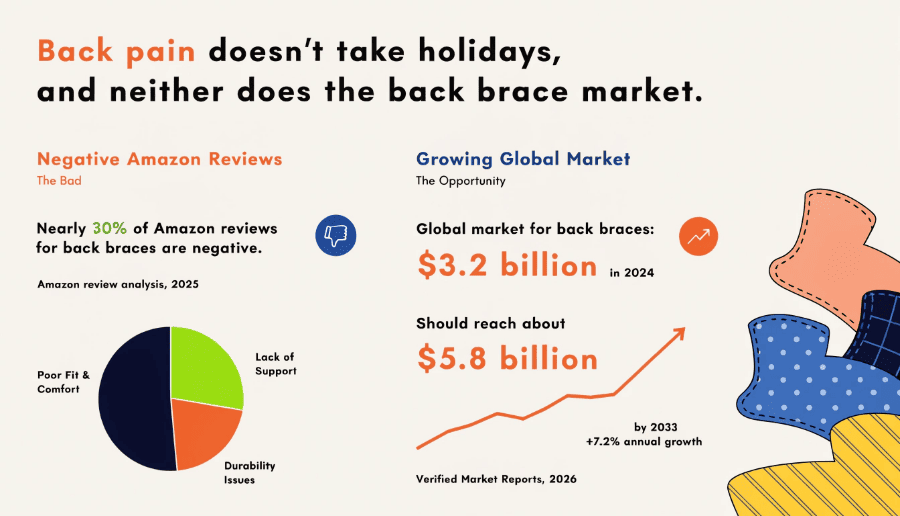
Back pain doesn't take holidays, and neither does the back brace market. Valued at $3.2 billion in 2024, the global industry should reach about $5.8 billion by 2033, growing around 7.2% annually (Verified Market Reports, 2026).
But here's what those headline numbers hide: nearly 30% of Amazon reviews for back braces are negative (Amazon review analysis, 2025), and most complaints cluster around the same handful of fixable problems.
For B2B buyers, this isn't a red flag. It's a roadmap. Every complaint points to a gap someone can fill.
Here are the seven most common complaints going into 2026 — and what you can do about each one.
1. Sizing confusion ("It doesn't fit right")
29.4% of negative posture corrector reviews and 14.1% of lumbar belt reviews mention sizing problems (Amazon data, 2025). Most sizing guides still ask for a single waist measurement, ignoring torso length and hip width.
The fix: Move to multi-point measurement guides, expand size ranges (XS–3XL), build in 30%+ strap adjustability, and include video fitting instructions via QR code on packaging. A customer who nails the fit on the first try is roughly 3x more likely to repurchase (Industry conversion data, 2024).
2. Skin irritation and chafing
"It rubs my armpits raw." About 16% of posture corrector users report skin irritation (Amazon review analysis, 2025). Neoprene traps heat; rough seams create friction points. Physical therapists say skin breakdown is the #1 reason patients abandon prescribed braces (ScoliCare Clinical Research, 2024).
The fix: Use hypoallergenic 3D-knit fabrics1 with flat-lock seams, add padded underarm zones, swap rough elastic for silicone grip strips. One simple move that works: recommend wearing a thin undershirt beneath the brace. ScoliCare data shows this cuts skin irritation by over 60% (ScoliCare Clinical Research, 2024).
3. Excessive sweating and overheating
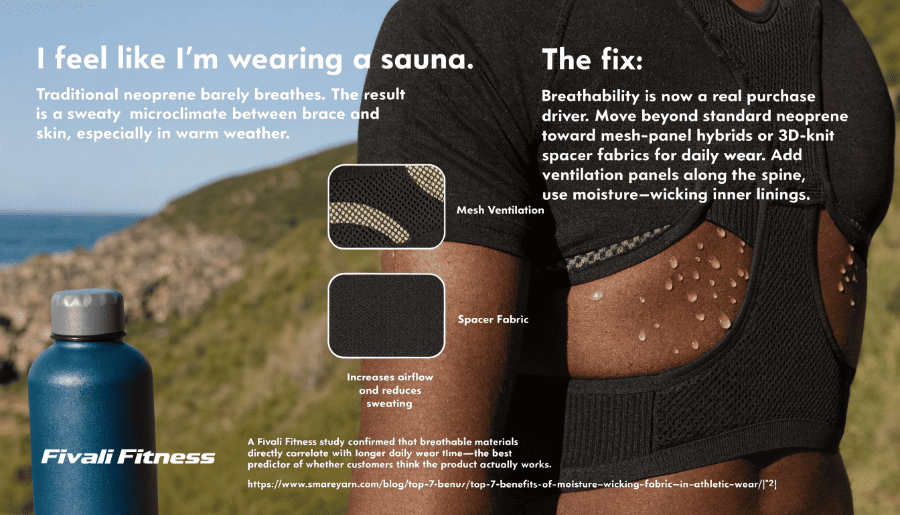
"I feel like I'm wearing a sauna." Traditional neoprene barely breathes. The result is a sweaty microclimate between brace and skin, especially in warm weather.
The fix: Breathability is now a real purchase driver. Move beyond standard neoprene toward mesh-panel hybrids or 3D-knit spacer fabrics for daily wear. Add ventilation panels along the spine, use moisture-wicking inner linings2. A Fivali Fitness study confirmed that breathable materials directly correlate with longer daily wear time — the best predictor of whether customers think the product actually works (Fivali Fitness Lab Report, 2024).
4. Muscle dependence ("My back feels weaker")
This is the most serious complaint because it attacks the clinical rationale for wearing a brace at all. Physical therapists warn that all-day, every-day use causes core muscle atrophy3 (Physioster PT Survey, 2025). When external support takes over, your stabilizing muscles shut down, then weaken, then you need the brace even more. It's a vicious cycle.
The fix: Build intermittent wear protocols into product guides (recommend 2–6 hours during high-risk activities like lifting or desk work). Offer dual-tension strap systems so users can tighten during activity and loosen at rest. Bundle core-strengthening exercise guidance with every brace. Position the product as a training tool, not a permanent crutch.
5. Poor discreetness ("It shows under my clothes")
Professional adults make up 44.42% of the addressable market for posture correctors (Accio Market Insights, 2025). For this group, invisibility isn't optional. If it shows through clothing, they won't wear it to work.
The fix: Slim profiles under 5mm thickness outside structural areas. Contoured silhouettes following the natural spine curve instead of creating a rectangular bulge. Neutral colors (black, charcoal, nude) that disappear under light shirts. Consider marketing an "Office Series" variant — this segment pays more when invisibility is part of the value proposition.
6. Durability concerns
"Velcro stopped sticking after two weeks." Quality complaints account for 15.6% of negative reviews, durability issues another 7.3% (Amazon review analysis, 2025). Common failures: fasteners losing grip, buckles cracking, elastic stretching out permanently, seams splitting.
The fix: Upgrade to industrial-grade hook-and-loop4 rated for 10,000+ cycles (ANSI/AAMI testing standard), reinforced polymer or metal buckles, high-memory elastane blends, bar-tack stitching at stress points. Offer a 12-month warranty on structural components. For B2B partners, sub-2% warranty rates become a strong selling point.
7. Lack of clear usage guidance
"How tight should I wear this?" "Can I sleep in it?" Informational confusion gets overlooked but causes real damage. Customers get a brace with no instructions, wear it wrong, get poor results, and leave angry reviews for a product that might have worked fine.
The fix: Include an illustrated quick-start guide, a simple "two-finger test" for proper tension, breathing checks, activity-based wear schedules, and realistic timelines ("most notice improvement within 2–4 weeks"). Add QR codes linking to video tutorials. Costs almost nothing, dramatically improves success rates.
Quick reference: All seven issues at a glance
| # | Issue | % of complaints | Fix difficulty |
|---|---|---|---|
| 1 | Sizing | Up to 29.4% | Low-medium |
| 2 | Skin irritation | ~16% | Medium |
| 3 | Overheating | Universal | Medium-high |
| 4 | Muscle weakness | Serious but less frequent | Low |
| 5 | Bulkiness | ~16% (armpit area) | Medium |
| 6 | Durability | ~22.9% combined | Low-medium |
| 7 | Poor guidance | Overlooked category | Low |
None are unsolvable. Each has documented solutions ready to implement.
What to ask suppliers in 2026
If you're sourcing back braces for retail, private label, or healthcare distribution, run potential partners through these seven questions:
- Sizing: What's your return-due-to-fit percentage?
- Materials: Do you offer hypoallergenic and breathable options?
- Muscle dependence: How does your design address this concern?
- Discreetness: Is there a low-profile professional variant available?
- Durability: What are your component specs and warranty terms?
- Guidance: What instructional materials do you include?
- Performance data: Can you provide breathability or thermal ratings?
Suppliers with specific answers have done the work. They're turning complaints into product specs, and product specs into market share.
The back brace market doesn't lack demand. It lacks alignment between what customers need and what most products deliver. Seven complaints. Seven opportunities. One question worth asking: are the manufacturers you're working with actually listening?
FAQ
1. What is the most common complaint about back braces?
Sizing and fit issues are the #1 complaint, affecting up to 29.4% of negative posture corrector reviews and 14.1% of lumbar belt reviews on Amazon (2025 data). The root cause is outdated single-measurement sizing guides that ignore torso length and hip width. The solution: multi-point measurement systems, expanded size ranges (XS–3XL), straps with 30%+ adjustability, and video fitting instructions accessible via QR code on packaging.
2. Do back braces cause muscle weakness?
Yes, if worn incorrectly. Physical therapists warn that continuous all-day use can lead to core muscle atrophy — when external support takes over, stabilizing muscles weaken over time, creating dependency. The evidence-based approach is intermittent wear: 2–6 hours during high-risk activities (lifting, prolonged desk work), not 24/7. Look for products that include wear schedules and core-strengthening exercise guidance.
3. Which back brace material is best for all-day comfort?
3D-knit spacer fabrics and mesh-panel hybrids outperform traditional neoprene for extended wear. Neoprene traps heat and moisture, causing sweating and skin irritation reported by roughly 16% of users. Breathable alternatives with moisture-wicking inner linings, flat-lock seams, and ventilation panels along the spine correlate with significantly longer daily wear time — which research shows is the strongest predictor of customer satisfaction and perceived effectiveness.
4. What should B2B buyers look for in a back brace supplier?
Focus on seven key criteria: (1) return-due-to-fit rate (ask for their actual percentage), (2) material options (hypoallergenic + breathable variants available?), (3) muscle-dependency mitigation (design features or wear protocols?), (4) low-profile/discreet options for professional segments, (5) component specifications and warranty terms (12-month minimum recommended), (6) instructional materials included (quick-start guide, video QR codes?), and (7) performance data such as breathability or thermal ratings. Suppliers with documented answers to these questions are actively solving customer complaints rather than ignoring them.
5. How long does it take to see results from wearing a back brace?
Most users notice meaningful improvement within 2–4 weeks of consistent, correct use. However, results depend heavily on proper fit, appropriate wear duration, and using the brace as a supportive tool during activity — not as a permanent replacement for core strength. Products that set realistic timelines and include usage guidance (such as the "two-finger test" for strap tension) see far fewer negative reviews and higher repurchase rates.
Disclosure & Affiliate Notice
Transparency Statement: MediSoleMates is a B2B orthopedic products manufacturer specializing in back braces, posture correctors, and related supportive devices. While this guide is designed to help retailers, distributors, and healthcare buyers make informed sourcing decisions, we may have a commercial interest in the recommendations provided. Some supplier relationships or product categories mentioned may involve affiliate partnerships or wholesale arrangements. This content is for informational purposes only and does not constitute medical advice. Always consult with healthcare professionals for clinical recommendations.
Data sources: Verified Market Reports (2026), Grand View Research, Accio Market Insights (2025), Amazon review analysis (2025–2026), Physioster PT Survey (2025), Fivali Fitness Lab Report (2024), ScoliCare Clinical Research (2024), Industry conversion data (2024), ANSI/AAMI testing standards.
Explore how these materials can improve comfort and reduce skin irritation. ↩
Find out how advanced materials can lead to longer wear times and happier customers. ↩
Understanding this condition can help users avoid dependency on braces. ↩
Explore the importance of durability in ensuring long-lasting products. ↩
